INJECTABLES
Botox® Cosmetic
Refreshed, Not Frozen
Botox softens expression lines caused by repeated muscle movement, creating a smoother, refreshed appearance while preserving natural expression.
Physician-Led Care | Personalized Treatment
Model
INJECTABLES
Botox softens expression lines caused by repeated muscle movement, creating a smoother, refreshed appearance while preserving natural expression.
Physician-Led Care | Personalized Treatment
Model
Your face is rarely still. You smile, squint, raise your eyebrows, laugh and react throughout the day. Those movements are part of what makes your face recognizable, and they are an important part of how we approach BOTOX® Cosmetic at Balikian Plastic Surgery.
Our aesthetic providers are not simply looking for wrinkles to erase. They are looking at how your face moves, where certain muscles are working more strongly than others, and how relaxing one area may change the balance of your expression.
The goal is not a motionless forehead or a face that looks obviously treated. It is to soften what is bothering you while preserving the expressions that still look like you.
BOTOX® Cosmetic temporarily reduces activity in selected facial muscles. That makes it particularly useful for dynamic lines, the lines created or intensified when the muscles beneath the skin contract.
Think about what happens when you raise your eyebrows and horizontal lines appear across your forehead. Or when you frown and the vertical “11” lines become more pronounced between your brows. Or when you smile and lines form beside your eyes.
BOTOX® allows us to selectively reduce some of that muscular activity.
But knowing that a muscle can be relaxed is very different from deciding whether it should be, how much it should be relaxed, and what effect that will have on the rest of the face.
That is where the treatment becomes individualized.
A BOTOX® consultation at Balikian Plastic Surgery is not just an evaluation of your face at rest. Our aesthetic providers wants to see what happens when you animate. Raise your eyebrows. Frown. Smile. Squint.
Those expressions reveal how your muscles are actually working and can help our aesthetic providers understand why a particular line is forming or why one area may appear heavier, stronger or different from another.
Two patients can point to exactly the same forehead line and need very different treatment. That is why we do not believe BOTOX® should be approached as a standard injection pattern.
Our aesthetic providers use BOTOX® to address a range of concerns related to facial muscle activity.
These include:
The consultation also helps determine when the answer isn’t BOTOX®.
A concern that looks like a wrinkle may be influenced by skin quality, volume loss, facial structure or a combination of factors. More BOTOX® is not automatically the solution.
Before and After
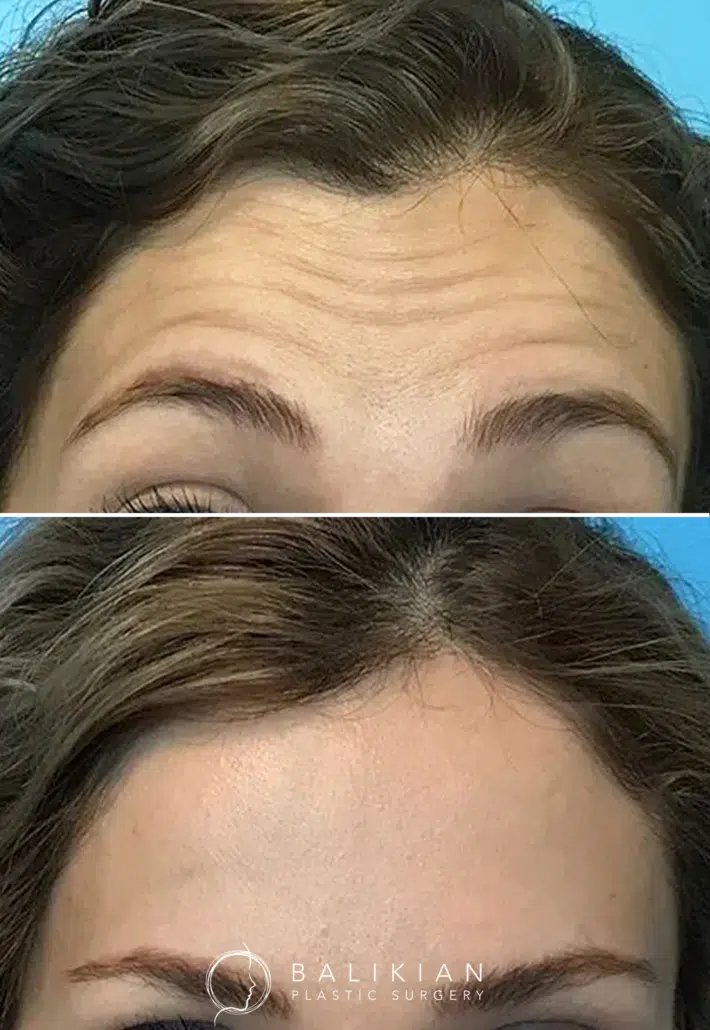
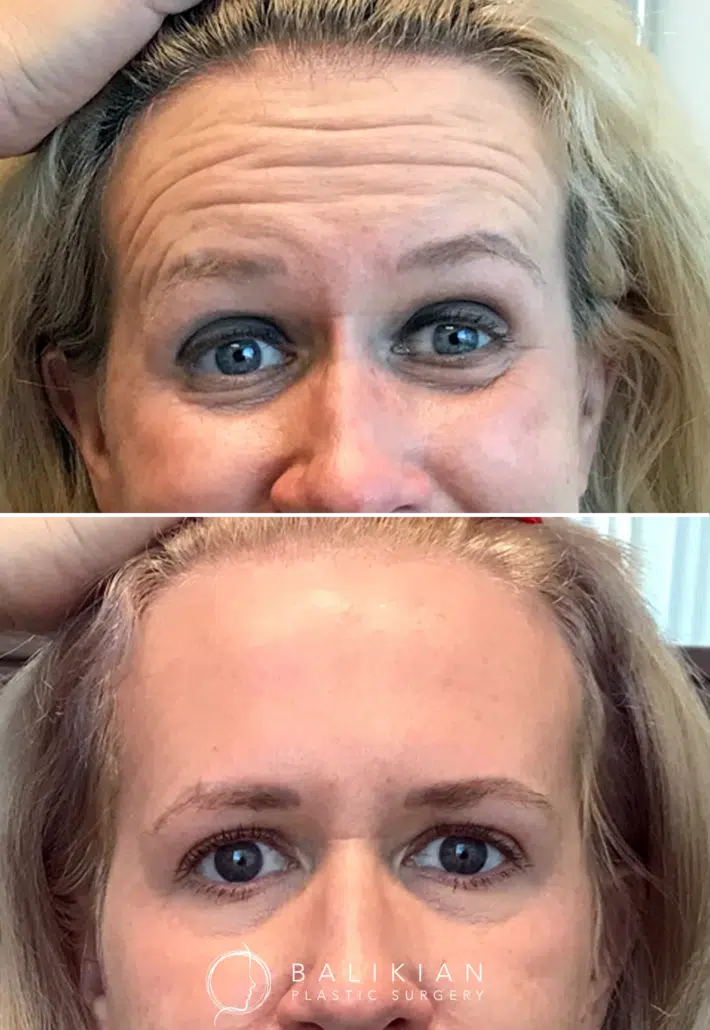
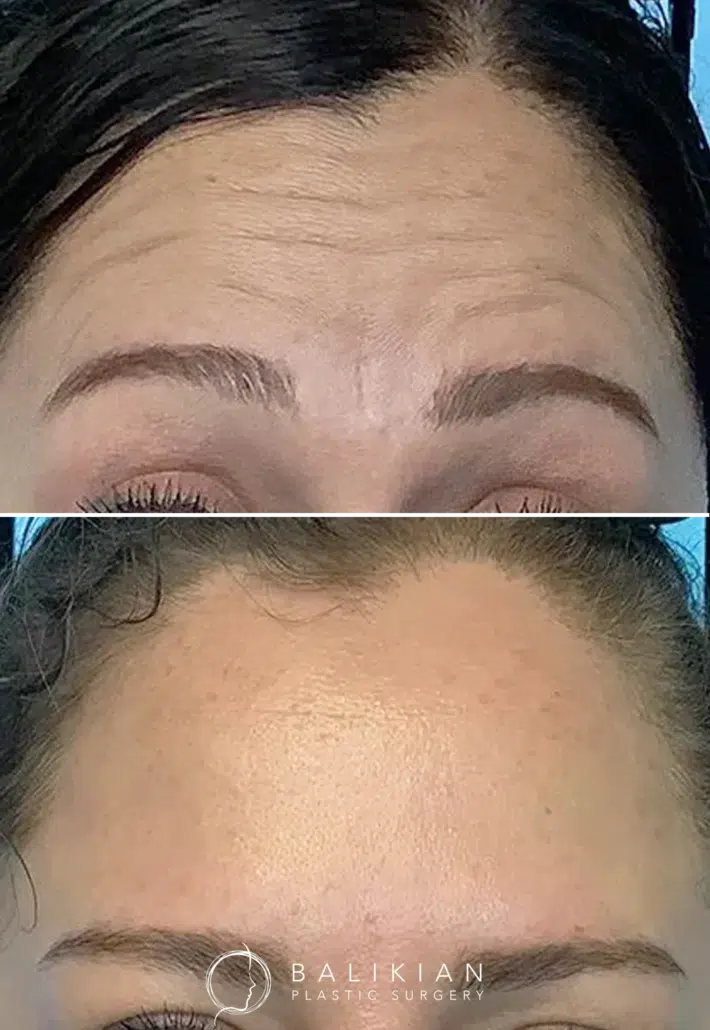
These before and after photos reflect our aesthetic providers’ approach to BOTOX® Cosmetic: softening unwanted lines and excessive muscle activity while preserving the natural movement, balance and expression that make you look like yourself.

One of the most common things we hear from patients is some version of:
“I don’t want to look frozen.”
– Patient
Neither do we.
Movement is not something that automatically needs to be eliminated. The objective is to identify the movement contributing to the concern and determine how much of it should be softened while maintaining a natural expression.
For one patient, that may mean a very subtle treatment that leaves considerable movement. Another patient may prefer a smoother result.
Neither approach should begin with an arbitrary number of units. It should begin with the person sitting in front of us.
It can actually be easier to create an obvious change than a subtle one. A natural result requires judgment about where to treat, where not to treat and when enough is enough.
That restraint is important because facial muscles do not operate independently. They interact. Changing the activity of one muscle can influence the appearance or movement of another area.
Our providers consider those relationships when developing a treatment plan rather than chasing every visible line.
The result we are looking for is not:
“You got BOTOX®.”
It is:
“You look rested.” “You look refreshed.” “You look good.”
Your appointment begins with a conversation about what you are seeing and what you would like to change. Our aesthetic provider will evaluate your face at rest and in motion before determining the areas that may benefit from treatment. Small amounts of BOTOX® are then placed into selected muscles using a fine needle.
The injections themselves generally take only a few minutes, and most patients return to their normal routine shortly afterward.
BOTOX® does not take effect immediately. Muscle activity gradually decreases after treatment, with the result developing over the following days.
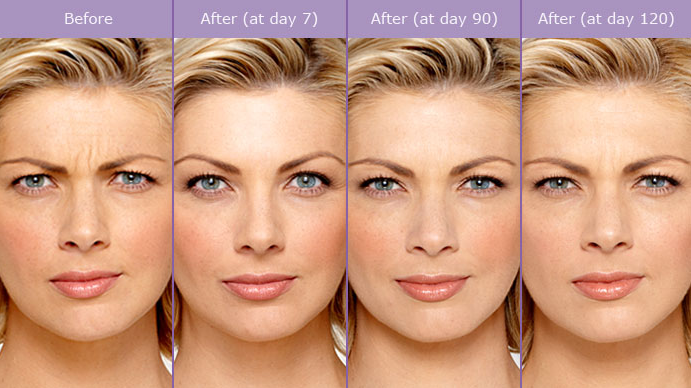
Results are temporary and commonly last approximately three to four months, although this varies from patient to patient.
Your first treatment does not have to establish a formula that gets repeated indefinitely. Your preferences can change. Your facial movement can change. Your face itself changes over time.
Each appointment is an opportunity to look again.
Our aesthetic provider can evaluate how the previous treatment worked, what you liked, what you might want to approach differently and whether the same treatment still makes sense.
That ongoing relationship is one of the advantages of having an aesthetic provider who knows your face rather than simply repeating an injection map.
Sometimes the concern a patient points to is caused primarily by muscle movement, making BOTOX® an excellent option. Sometimes it isn’t.
Skin quality, pigmentation, volume, facial structure and muscle activity can all contribute to how the face ages. Our aesthetic providers have multiple ways to address those changes, which means the consultation does not have to begin with the assumption that BOTOX® is the answer.
It begins by figuring out what is actually creating the concern.
From there, we can decide what to treat, what to leave alone and how to help you look healthier, less tired and more like yourself.
Take the Next Step
If expression lines, jaw tension or other concerns related to facial muscle activity are bothering you, our aesthetic providers can help determine whether BOTOX® is the right approach.

Frequently asked questions
Get answers to common questions about BOTOX® treatment, results, recovery and what to expect.
Will my face look frozen or expressionless after Botox®?
Not when performed by experienced injectors. Our goal is to soften lines while preserving natural expression and movement.
Can I get Botox® while pregnant or breastfeeding?
No. Botox® is not recommended during pregnancy or while breastfeeding.
Can I fly on an airplane right after Botox®?
Yes. Flying after Botox® is safe. However, we recommend avoiding pressure on the treated areas for a few hours post-treatment.
How soon after Botox® can I wear makeup?
You can apply makeup a few hours after treatment, but avoid massaging or rubbing the treated areas to prevent the product from moving.
Is there anything I should avoid after Botox®?
Yes. Avoid strenuous exercise, lying down flat, or applying pressure to treated areas for at least 4 hours after injection.
Can Botox® help with migraines or excessive sweating?
Yes. Botox® is FDA-approved for chronic migraines and excessive underarm sweating (hyperhidrosis), though these are medical treatments and require a different consultation process.
How many units of Botox® will I need?
The number of units depends on the treatment area, your muscle activity, and your aesthetic goals. During your consultation, we’ll create a plan tailored to your needs.
How long do results usually last?
Most glabellar-line studies still show a typical effect window around 8–12 weeks, though individual duration varies with dose, placement, and muscle activity.
Does dose or injection strategy change how long it works?
Yes. Trials comparing different BoNT-A products and dosing strategies show similar onset but small differences in duration depending on formulation and total units used. Technique and correct placement matter as much as the brand.
Can Botox improve oily skin, visible pores, or overall “skin quality”?
Evidence from recent reviews and meta-analyses of intradermal (“micro-”) BoNT-A suggests reductions in sebum production and pore size, with improvements in texture and erythema. These are promising but based on small trials; larger studies are needed.
Can my body “get used to” Botox and make it stop working?
It’s uncommon, but repeated high doses and very short reinjection intervals may increase the chance of neutralizing antibody formation, which can blunt results. Using the lowest effective dose and spacing treatments appropriately can help reduce that risk.
Do supplements make Botox last longer?
Some small studies have explored zinc and other supplements, but evidence is inconsistent. Right now, supplements aren’t considered a proven way to extend results.
Patients love the Aesthetics at Balikian Plastic Surgery for its welcoming atmosphere, advanced technology and natural results.
Continue Learning
Learn more about injectables, skin rejuvenation and other non-surgical treatments available at Balikian Plastic Surgery, including how our aesthetic providers approach treatment planning and natural-looking results.